Saturday Night Poetry Pub Quiz

7 Oct
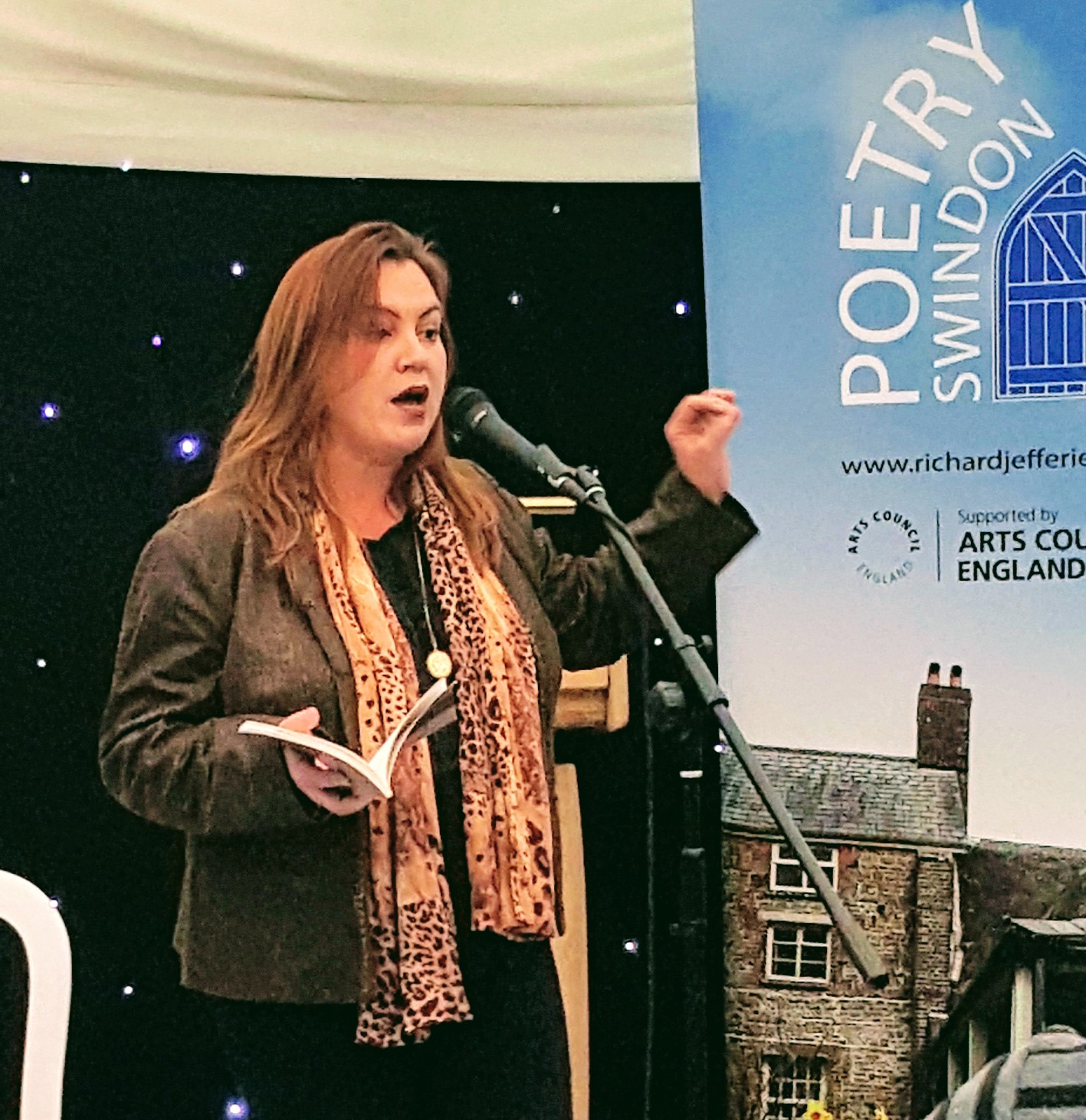
Carrie gets the quiz going

Carrie gets the quiz going

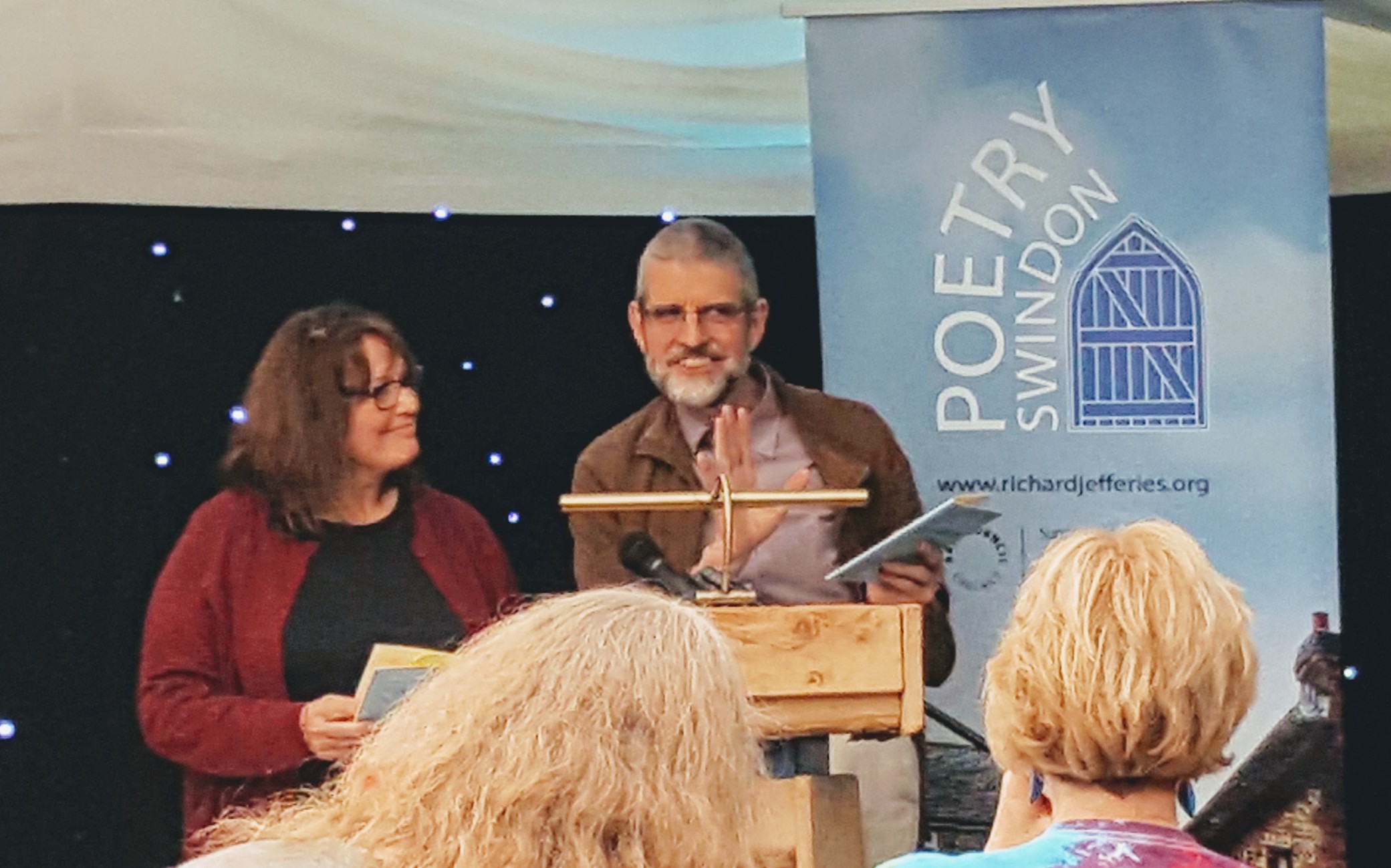
After the excitement of the Battered Moons competition, after a rainy day and after Swindon’s ‘People’s Poet’ Tony Hillier had doled out silly hats for everyone, Carrie Etter took the mic and the serious business of the Festival got started – Carrie’s carefully crafted Poetry Pub Quiz.

Bethan & Sophie

Bethan & Sophie on the book stall

Very quickly I realised that teams had been forming all weekend – anyone who had given off an air of knowing a lot about poetry were sought after as team mates. Sadly I hadn’t been poached or even approached so my poetry creds must be rock bottom. But at least I knew the name of the US Poet Laureate – just saying. Meanwhile I heard quite a few jealous whispers about Jill Abram who had suddenly appeared and was apparently highly sought after.

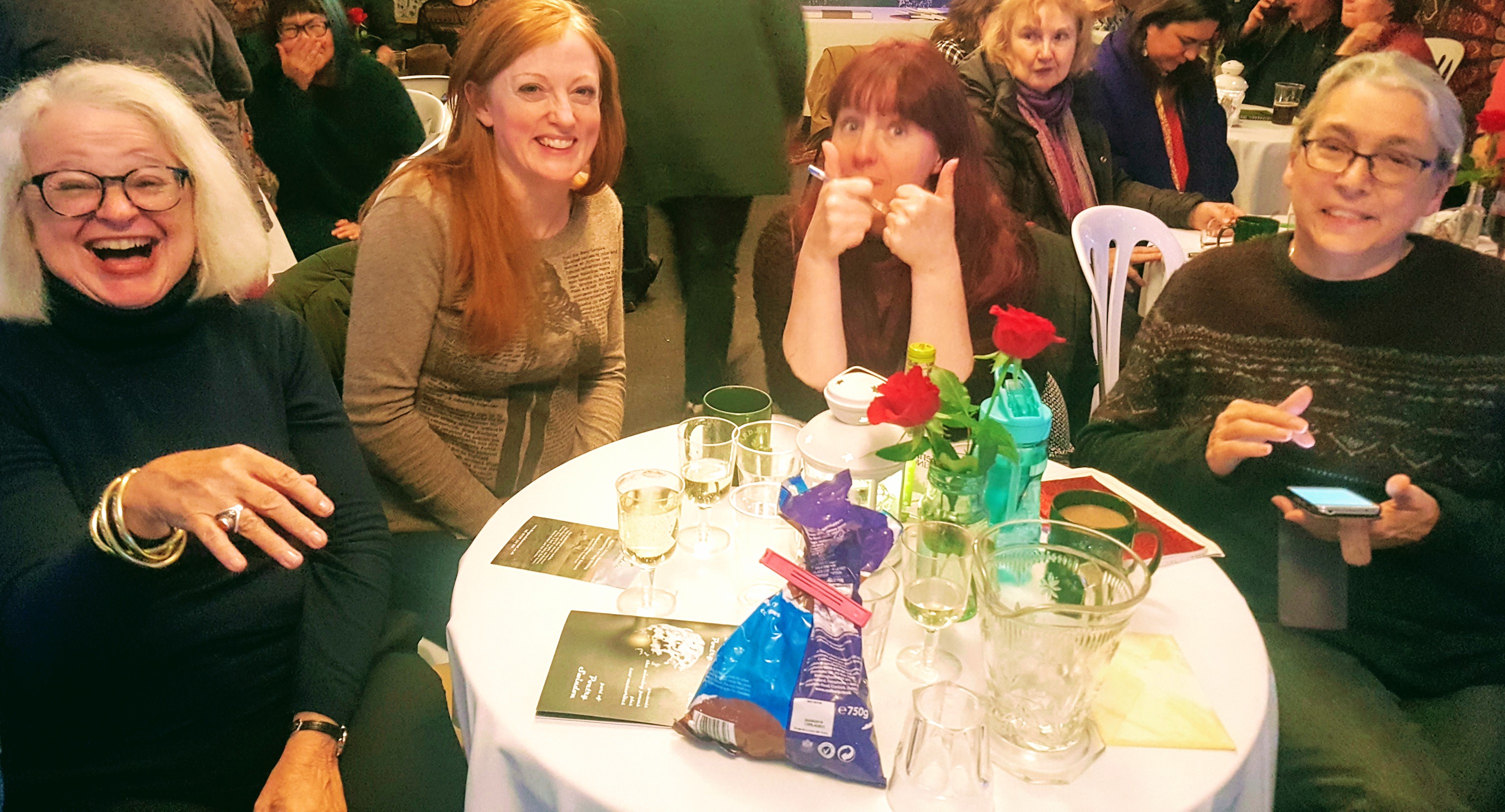
Before the gloves were off I took photos of the teams, asking them if they thought they were going to win. Judge for yourself who did (or didn’t) display the killer instinct!

Hilda's team

Pub quiz team

pub quiz team

pub quiz team

And the winners? Well, the dream team of Clare Shaw, Kim Moore, Sarah Dixon and Jill Abram scooped the top prize… this morning I heard someone mutter slightly tetchily ‘it was like pitching Man U against Scunthorpe reserves.’ And all for a bottle of prosecco! Who’d have thought those poets could be so -AHEM – competitive?!

Saturday: Carrie Etter reading

7 Oct
Carrie Etter

Carrie Etter

Saturday: after a tea break the rain was abating and a packed tent was treated to a wonderfully strong reading from Carrie Etter, who’s something of a darling with the Poetry Swindon audience. Hardly surprising given all that she does for the local/regional poetry scene. The Tent Palace was aglow with love!

Before the reading there was a lovely speech/farewell from Festival Founder/Director Hilda Sheehan. Hilda has relocated to Belgium, but she wanted to not only thank everyone who had worked hard for and supported the Festival, but also reassure us that it would continue, and get better and better. There was a special thank you to Helen Dewbery for taking on the organisation late in the day, and bringing the festival to fruition. We love Hilda!

And so to Carrie. She read from her collection The Weather in Normal (Seren), (so-named for Carrie’s original home town of Normal, Illinois.)

After opening with ‘Night Ode’, she told us how her father had been obsessed with watching weather reports, and even after she had moved away he would call her up to tell her the weather forecast for where she was.

Carrie calls the book ‘a eulogy to my Illinois’, and told us about her journey from Normal to California aged 19, and from there to England… although she still ‘returns to Normal once a year’.

A sense of loss – for her parents, her home, but also the effects of climate change on the landscape she grew up in – pervade the book. But she told us it’s also ‘a celebration of the place and the people.’

Here’s the last poem she read, ‘Trying to Say’:

Saturday: Liardet, Shearsman & Magma

7 Oct
Helen Dewbery

Helen Dewbery

It’s Sunday morning and I’m just writing up my notes from yesterday at the Swindon Festival of Poetry. There seems to be a fat wodge of them – oh dear. But I couldn’t help it – so much to write down .

Tim Liardet reading

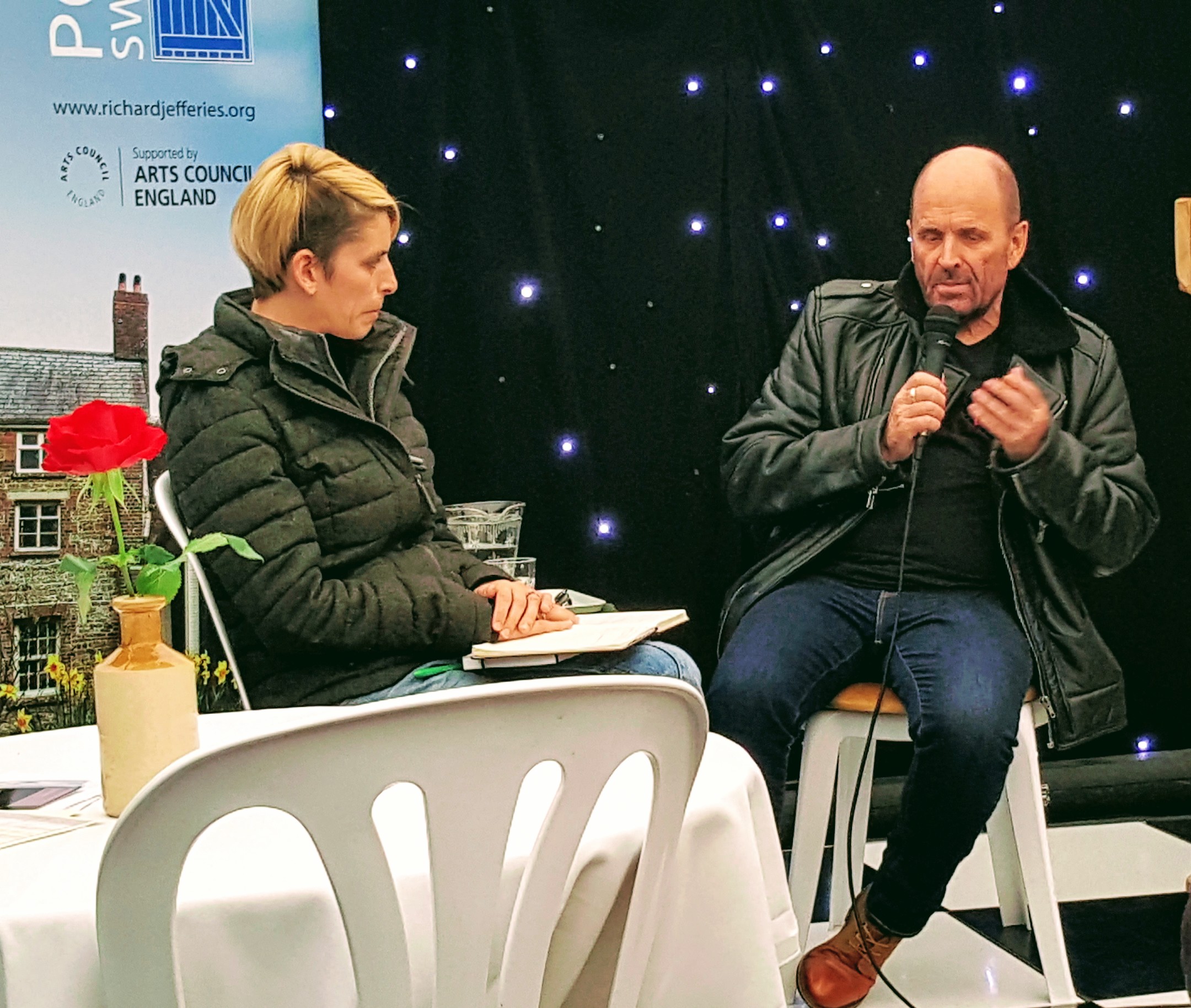
Festival Director Helen Dewbery introduced Tim Liardet (“Lee-ar-day”, for those of us who weren’t sure) who gave a short reading, after which he was interviewed by Kim Moore.

Tim has written ten collections and been shortlisted for the T S Eliot Prize twice; he’s also Professor of Poetry at Bath Spa University. He was talking about, and reading from, his ‘new and selected’ collection Arcimboldo’s Bulldog (Carcanet). Interesting to hear about the kinds of dilemmas facing a poet who reaches such a stage in their career – Tim wondered: what do you do with a ‘new and selected’? It’s not eligible for any of the prizes, he doesn’t want to jeopardise his next collection by including poems from that (the next collection, by the way, is more or less written.) To those of us poets a long way down the food chain these are ‘first world problems’… but fascinating nonetheless.

Arcimboldo’s Bulldog starts with Tim’s new work and then plunges into the earliest poems, dating from 1996. He admitted there were weren’t a lot from that period he wanted to include. In the Q&A with Kim that followed, he said he felt he only started to write in about 2006, when he began teaching in a high security prison, and ‘had to find a new register’. Before that he was ‘only trying to write…[…]  the older poems… I can’t hear them any more.’

Tim read a number of poems from the latter sections of the book, starting with ‘Loy’s Return’, an ‘apocryphal tale of an inmate returning to the outside world’. Another event that shaped his writing was the tragic drowning of Chinese cockle pickers in Morecambe Bay in 2004. He told us he wanted to respond to this by creating a mythology around it, to ‘put a marker in the ground’, particularly as he felt it was made so little of by the media.  Tim read a poem called ‘Riding the Ghostly Velocipede’ in which he explored the topic through the means of a near-drowning experience from his childhood.
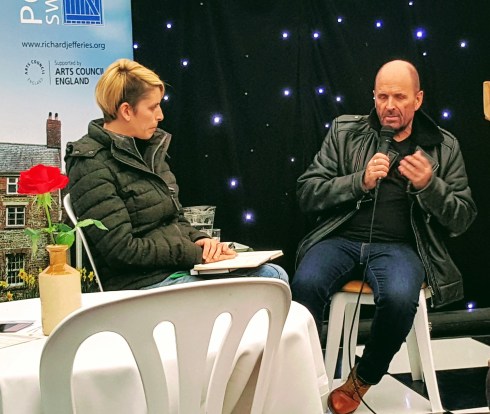
Kim Moore and Tim Liardet

The Kim n Tim Show

In the interview that followed, there was some discussion of issues such as appropriation – how does a poet write about events without taking responsibility for telling someone else’s story? Tim’s answer (as regards the cockle pickers) was that he didn’t want to imagine/tell their stories, but rather create a monument to them. Another question was in what ways did living in the US affect his writing. Tim response was that he felt a sense of spaciousness in the US, rather than the claustrophobia of here. He reads John Ashbery every day and feels his writing somehow personifies this spaciousness.  ‘Precision doesn’t exist in density’.

Kim did a great job having stepped in at the last minute when the scheduled guest Jennifer Militello was unwell.

Poets & Publishers

The mid-afternoon session was a roundtable chaired by Carrie Etter with guests Tony Frazer of Shearsman and Laurie Smith, one of the founding editors of Magma.

Shearsman was founded in 1981 and publishes a twice-yearly magazine as well as books – 51 books in 2017 alone – and Tony Frazer does it all himself – pretty amazing. Interestingly he described himself as ‘a reader, not a writer’. 15% of Shearsman publications are in translation and another 10% or so are works by US or Antipoedean authors.  Tony told us how his background was in reading mainly US poetry, which no doubt informs his tastes. I’ve always thought of Shearsman as being relatively avant-garde, so much so that I don’t think I’ve ever submitted anything there, but Tony claimed that what he liked was quite broad – from sonnets to explosions of phonemes across the page. It can all be fine  “if it works!”

Magma magazine, as Laurie explained, has always had two different editors for each issue, something that he admitted did mean there was no consistently recognisable style or ‘type’ to what it publishes.  He also described how for each issue the magazine received an average of 2,500 submissions. That’s a lot of poems to read!  But it was noticeable from both editors that they took the responsibility of reading seriously, otherwise, as Laurie said, ‘each poem that comes in gets the same level of attention – or you might miss something.’

Here are a few of the questions and answers:

Q: Would they ever start charging for submissions, as is common in the US?

Tony: no

Laurie: we wouldn’t dream of it. We’d like to be able to pay contributors, not the other way around.

Q; What do you think of simultaneous submissions?

Tony: it’s OK, although he’d like to be told (particularly in the case of books under consideration)

Laurie: you can’t prevent simultaneous submissions. It’s really up to the editor to get through the submissions in a timely way, you can’t expect people to wait six months before sending a poem about again.

Q: Who are you most proud to have discovered?

Laurie: Jen Hadfield

Tony: Janet Sutherland (I was very happy to hear this as Janet is a friend, and co-member of the Needlewriters collective in Lewes.)

Q: Would you ever move your magazine away from print and go completely digital (like The Interpreter’s House)?

Tony: no, although he may offer a digital version of the print magazine.

Laurie: Magma already has a digital edition but it would never going entirely digital. “There will always be a place for poetry on paper,” said Laurie, holding up a copy of Magma, “this will still be around in 100 years.”

Q: What would be your one piece of advice to someone thinking of submitting their work to you?

Tony: read a sample of what we publish – there are plenty of PDF downloads available on the website.

Laurie: Express strong emotion in original language.

Friday Night: Moore, Holloway Smith, Shaw

6 Oct
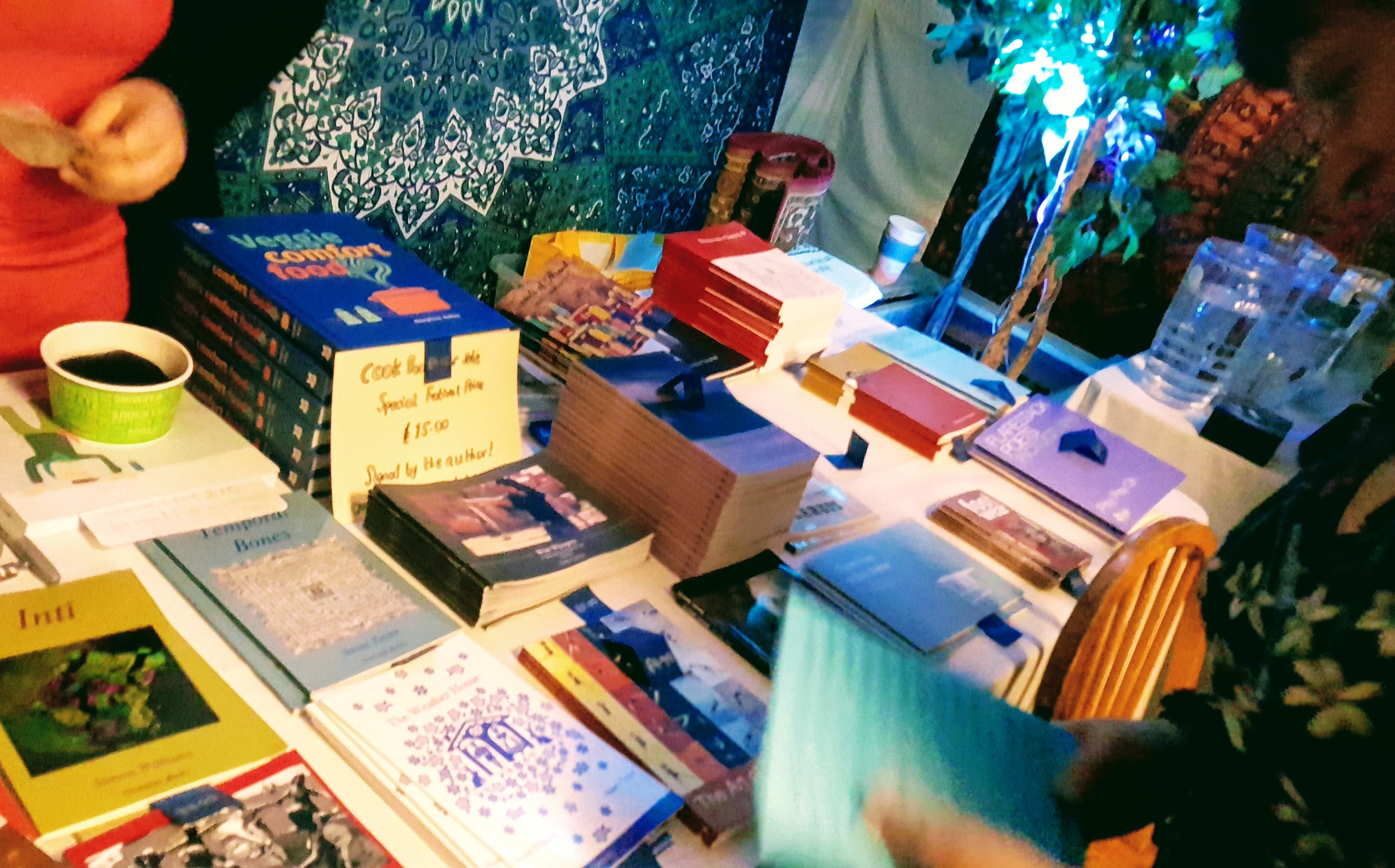
Poetry books for sale Poetry books for sale

Friday night: The Tent Palace was heaving with anticipation (and the sound of people singing and dancing wildly to Tina Turner and John Denver – no really – we poets know how to let our hair down – speaking of which, having left my hairbrush at home (did I mention that already?) I decided to cover up with a bobble hat. I just hope it didn’t obscure anyone’s view.) Continue reading

Friday afternoon open mic

6 Oct
In the garden at the Richard Jefferies Museum In the garden at the Richard Jefferies Museum

Yesterday afternoon at the Festival began with an open mic session within which two longer reading slots were given to myself and Anna Saunders. Continue reading

Frog on Water Steal the Bricks – Wild Whispers

6 Oct

Wild Whispers, poetry film project, began with Frog on Water, a poem by producer Chaucer Cameron about connectivity/disconnect, with the backdrop of the personal – a house move – and the political – Brexit.

She had this simple but ambitious idea (the best kind): send it out to her poetry collaborators across the globe one-by-one, to translate it, turn it into a film, and pass it on. Whispered.

I used to walk through woodland and wild garlic,
watch leap of frog, gold-green on water.

Would it be lost in translation? Well yes and no. Continue reading

As evening falls on National Poetry Day…

5 Oct
In the Tent Palace of the Delicious Air, Swindon Festival of Poetry In the Tent Palace of the Delicious Air

Since my last post I’ve had a swim, eaten breakfast, been to a workshop, missed lunch (my bad) and given a short reading as part of a marathon open mic session. But more (or less) about that later – I’m playing a game of catchup here!

First of all … the night was young and the (faux) stars were out in the Tent Palace as National Poetry Day at the Swindon Festival of Poetry continued yesterday.

Chaucer Cameron gave heartfelt introductions to three readers all with new publications: Stephen Payne, Louisa Campbell and Josephine Corcoran.

Stephen Payne told us a little about his background as a psychologist and academic cognitive scientist – it’s always interesting to find out what diverse world poets come from. He read from a sequences of poems he’s called ‘Euclid for Beginners’, in which seemingly simple geometric shapes (box, point, line, triangle for example) are explored (‘…a plane is a surface where deep stuff happens’). Continue reading

Swindon Poetry – Into the Tent Palace

5 Oct
Isobel Palmer and Philip Gross

Isobel Palmer and Philip Gross

It was National Poetry Day yesterday and what better way to celebrate it than at the Poetry Swindon Festival?  I’m Robin and I’ll be blogging over the next couple of days about some of the sessions, and the experience generally – alongside Festival Chronicler Louisa.

I made it into the Tent Palace of the Delicious Air, on the lawn of the Richard Jefferies Museum, just as an open mic was in full swing. We heard a poem about a ‘Smart Toaster’. Angi Holden read from her collection ‘Spools of Thread’. Jinny Fisher offered a thoughtful piece on the experiences of boys in public schools. The fairy lights behind the stage blinked on and off, we broke for mugs of tea in the garden and suddenly I ran into Hilda Sheehan, Festival founder/director, back from Belgium for the weekend and looking younger and bouncier than ever. This festival is just as I remember it – quirky, warm and unpredictable. It’s four years since I was here and I’m greeted like an old friend. That’s Poetry Swindon for you.

The late afternoon session saw Flarestack‘s Isobel Palmer introducing three poets with recent Flarestack pamphlets: Anna-May Laugher, Pey Pey Oh and Philip Gross.

Anna-May’s background in mental health informed the powerful ‘Our house’ – presumably an ironic reference to the song by Madness, but less of a jaunty memoir than a desperately sad testimony of a young child living with his mother’s illness and its impact on all their lives. Anna-May’s set included a number of ekphrastic poems and plenty of humour too.

Pey Pey Oh, whose pamphlet is called Pictograph, introduced herself with ‘English is my second language’ and some nice background about her life. Much of her set focused on the journey she took ‘wandering around China not speaking Mandarin’.  These were evocative poems full of wry observation (‘the boy with the beautifully sullen face’) and all delivered with Pey Pey’s warmth and charm. We learnt she had three grandmothers, one of whom ‘had bound feet and was married to an opium eater.’ I think that detail alone would have won over the audience.

The final of the three readers, Philip Gross, explained that his pamphlet Shadowplay was actually a collaboration with an Australian, Jenny Pollak, and centred on their exchanges over a period of time, in person and then by email, on the subject of light and dark. Philip explained how it was influenced by the Japanese form renga, in which poets ‘passed verses’  back and forth in a kind of sedate game of frisbee (at least, that’s the image I got!) We heard three extracts, with Isobel Palmer reading Jenny’s verses. There was a lot to think about here, from the nature of photography (‘soon we tire of it …(light) …and begin to long for the dark, its inwardness’  ‘Developing the Negatives’) to the universe itself and what we see when we look at ‘space’.

Full marks to Philip and Isobel for carrying on as the mic inexplicably sagged to around knee-height, and Sam Loveless for trying to fix it from the ground-up. But by the evening any small tech hitches were a dim memory.

One of the great things about this year’s festival is the proximity of everything – many of us are staying at the Holiday Inn across the road, about two minute’s walk, albeit one during which you need to stay alert. We had a health and safety briefing from Festival coordinator Helen in which she told us the only time to cross the road is when ‘you can’t see ANY cars coming’. There’s got to be some sort of metaphor here – a poetry festival divided by a road. Something to work up!


Upfest 2018 celebrates The Simpsons and women’s suffrage

30 Jul

This slideshow requires JavaScript.

Upfest celebrated its 10th anniversary this weekend with arguably its biggest coup to date.

After teaming up with the Mr Men in 2016 and Morph in 2017, organisers this year announced a collaboration with The Simpsons, and their creator Matt Groening, who handpicked three artists / teams to bring America’s most dysfunctional (until The Trumps came along) family in their own style.

So it was fitting, in a festival that also sought to mark the 100th anniversary of women’s suffrage, that some of those artists should be female. Continue reading

Festival Chronicle contributor turns spotlight on Swindon for new book

26 Jul
Angela Atkinson with her book Secret Swindon

Angela Atkinson with her book Secret Swindon

A new book revealing Swindon’s hidden gems will be officially launched this weekend by one of our own writers.

Festival Chronicle contributor Angela Atkinson turned her passion for the town into a blog, Born Again Swindonian. And having attracted a following from around the world, the blog has now spawned a book – Secret Swindon.

Continue reading