Archive | Swindon RSS feed for this section

Mark Lawson: allegedly

4 May
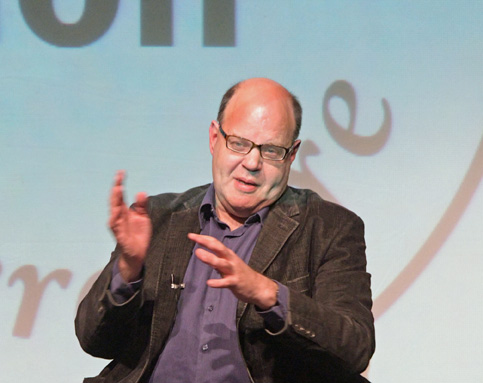
Mark Lawson

Mark Lawson ©Calyx Picture Agency

Mark Lawson: it could all be made up and still be true.

The words above are not mine but are taken from the entry in the literature festival brochure in respect of Mark Lawson’s talk last night at Swindon Arts Centre. When I saw them there on the page two words popped into my head: ‘fake news’. I wasn’t the only one to have that train of thought clearly because in the question session someone raised that very thing.

One has to wonder if, in the new order from across the pond of ‘alternative facts’ and ‘fake news’, the phrase ‘trumped-up charges’ doesn’t take on a whole new meaning?

So, The Allegations. A semi-autobiographical contemporary novel, set in a fictitious Midlands university, that explores the scenario of having ‘historic’* allegations made against you, and how you get through it and what it does to you.

And if the description ‘semi-autobiographical’ is too strong the novel is most certainly influenced by Lawson’s own experience. He recently stepped down from his long-running hosting role of BBC Radio 4’s culture show, Front Row, amid claims of bullying. Continue reading

So it IS all my mother’s fault!

4 May

I knew it! It IS all my mother’s fault! Or so the psychologist Oliver James would have us believe. Vindication is mine. *Evil Cackle*

In his poem This Be The Verse Philip Larkin famously said:

   ‘They f**k you up, your mum and dad.

    They may not mean to, but they do …. But they were f**ked up in their turn

    By fools in old-style hats and coats,…’
A sentiment not lost on psychologist Oliver James, Indeed not only is it not lost on him he’s channelled Larkin’s observation into his books They **** You Up and Not in Your Genes – the real reasons children are like their parents.

Continue reading

Migraine demons and the first ever caricature

4 May
Irving Finkel

Festival Director, Matt Holland with Irving Finkel (right) ©Calyx Picture Agency

Dr Irving Finkel doesn’t like to say he works in a museum. Not because he hates his job, on the contrary, Irving believes he works in the ‘best museum in the world, in the best job in the museum.’ The museum being the British Museum and the job being the cuneiform tablet curator. So why the reticence? Because people then expect him to be ‘dusty and boring’.

I’m pretty sure that anyone who meets Irving would have their expectations adjusted within 30 seconds. He is more one man show than monotone lecturer, adopting different accents in a talk punctuated by finger jabbing, foot stamping and casual swearing. He speaks many languages and exclamation marks feature in all of all of them. Continue reading

Birds, wheelchairs and bamboo sticks

3 May

Benedict Allen’s first meeting with BBC security correspondent Frank Gardner was inauspicious. Ben Fogle! He said (or something like it), I’m a huge fan!

Despite this, Benedict and Frank became big friends, with Benedict sharing his stories of the birds of paradise in the untouched jungles of Papua New Guinea of the 1980s. Turns out, Frank is a massive fan of bird watching, and his dream was to see those very birds.

Benedict was a semi-retired solo-adventurer. After three decades of exploring, he lost a husky on the Arctic ice and felt his luck had finally run out. So back he went home and began to raise a family.

But Benedict was inspired by Frank’s dream to see the birds. Especially so as the journalist’s mobility was reliant on a wheelchair after being shot in Saudi Arabia by terrorists. And, no doubt, excited by the extreme challenge of taking a wheelchair user to a remote, humid forest decidedly not accessible. Continue reading

Roam Alone – Tales of a reluctant traveller

3 May
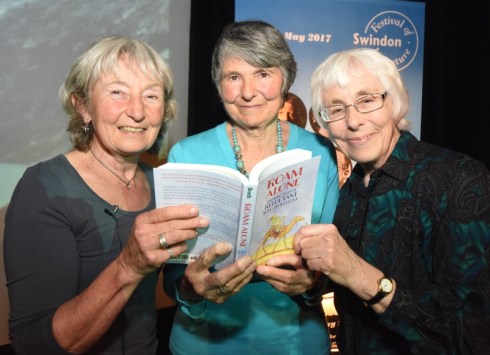
Hazel Pennington, Hilary Bradt and Janice

Hazel Pennington, Hilary Bradt and Janice Booth ©Calyx Picture Agency

Hilary Bradt, Janice Booth and Hazel Pennington told an attentive audience about their solo travelling where they felt the fear of being alone but carried on regardless.

Hilary’s book, Roam Alone also contains stories from other people (mainly women) who had travelled alone.  A common theme from them all was how nervous they felt, what would happen if they fell ill or faced threats and no one knew where they were in a foreign land.  However once they had actually travelled alone it felt wonderful.

Thirty years ago Hilary was just divorced but she decided to travel round Ireland by pony.  She bought a lovely pony, Mollie and then, with no support had to transport the luggage and saddle in relays.

Back then without sat nav, reliance was on maps.  Hilary’s map was lacking in detail and she had to rely on local advice for directions.  Travelling alone she found that people chatted to her but were especially interested in Mollie and even examined the pony’s teeth. Continue reading

A grass-fed message of hope

3 May
Graham Harvey

Graham Harvey (C) Calyx Picture Agency

I feel guilty about coming here with a gloomy talk, said Graham Harvey at the Swindon Festival of Literature.

Gloomy to me means pessimistic, lacking in hope. This talk, however, had a very clear idea of what we could do to fix things. And I hope this account gets all the facts right and does justice to his excellent talk.

The problem, according to Graham, is with modern agriculture. And the answer is to look back at the past. He showed us a Thomas Gainsborough painting, Mr & Mrs Andrews, in an idyllic North Essex setting. Gainsborough would have probably recognised the landscape right up until the 1960s, Graham told us, demonstrating with another picture – this time an aerial photo of the same, unchanged countryside – courtesy of the wartime Luftwaffe. In fact, the countryside hasn’t changed much since at least Roman times.

So what happened? Continue reading

From Aristocratic playground to American Hospital and Beyond – Lydiard House

2 May
Sarah Finch-Crisp

Sarah Finch-Crisp with Festival Director Matt Holland ©Calyx Picture Agency

Today was not the first time I’ve got soaked en route to a Swindon Festival of Literature event. I’m soooo glad I bought those new flip flips in the most recent Debenham’s Blue Cross Sale. Sigh.

So when my sodden self staggered into the room in the Lydiard House conference centre where the talk on the story of Lydiard House and Park was being held it was already pretty full. By the time the talk commenced it was standing room only.

Such a level of interest is unsurprising of course. In a town full of treasures of every kind Lydiard House and Park has to be Swindon’s equivalent to the Koh-i-Noor diamond. Both are much loved and the latter is much used. And, given the recent hullabaloo around SBC’s suggestion that management of it all go out to private tender, and everything around that, (to simplify the story somewhat) there was ever likely to be a big turnout.

The 260 acres of parkland we have today is what’s left of several thousand acres. Its survival is little short of miraculous. It’s extraordinary. And even better it’s in Swindon.

The fact that we’ve got it at all is largely down to the visionary town clerk David Murray John – he of the tower in the town centre. Facilitated by the philanthropy of Councillor Francis Akers who used his own money to temporarily buy the house and park in 1943, DMJ ensured the safety and preservation of Lydiard. And all at a time of graver national concerns. So thank goodness for them.

So what did I get from Ms Finch-Crisp to make my soaking worthwhile? Continue reading

Dawn Chorus and the case of the girl-eating cockerel

1 May


Chroniclers Milo (age 10) and Louisa (Mum) went to the Swindon Festival of Literature’s Dawn Chorus, the sunrise launch event at Swindon’s Lawn Woods. When they returned, Louisa asked Milo to write this chronicle but he was too tired after a 5.30am start. Meanwhile, Louisa (sensibly) like a grown up, went back to bed for a nap, while Milo played XBox. So Louisa, keytapping fingers refreshed, interviewed Milo instead. (In breaking news, lack of sleep makes a ten year old silly.) Continue reading

From cuneiform to graffiti – Swindon Festival of Literature has all writing bases covered

16 Mar

As Swindon Festival of Literature inches towards its quarter century, different methods of written communication – from the oldest to the very recent – will be celebrated this year.

Unveiling the 2017 programme at Swindon Library today (Thursday, March 16) festival director Matt Holland mused on how the way we use writing to communicate our thoughts is changing.

“In a digital world where the currency of topical commentary can be successfully and powerfully compressed into 140 characters – definitely a great method of instant communication – the book is still doing remarkably well,” he said. Continue reading

Andra Simons

14 Oct
Andra Simons

Andra Simons

Andra Simons blew me away.

The last poet to read at Poetry Swindon Festival – poetry was actually banned after him – and it felt a fitting send off.

“I heard him and thought he was special and wanted to share him,” said director, Hilda. This is the job of an artistic director as far as I’m concerned – to have impeccable taste.

Andra is from Bermuda; he yelled, he repeated words into a rhythm, he smeared facepaint all over his poetry film, he mentions LGBT issues, and showed his love for his mom.

Andra’s work could have been a tirade of bitterness. He’s the son of an illegitimate child who was called ‘the bastard’ at school – by the teachers – and it was assumed that neither Andra’s father or his offspring would amount to anything. Continue reading