Archive | Swindon Festival of Literature RSS feed for this section

Democracy and its Crisis

9 May
A. C. Grayling at Swindon festival of Literature

A. C. Grayling at Swindon Festival of Literature

A. C. Grayling took a packed and attentive audience right back to Plato when explaining about democracy.

The country was originally controlled by the aristocracy, where the King had absolute power given to him by divine right. Giving power to an ill informed public would result in anarchy and mob rule.

When Charles I was beheaded in 1649, a great change began in the idea of where authority lies and its source. The Levellers wanted the poorest in England to have as much right to a voice as the richest, with each individual (man) able to play a part in having a good enough government.

Over the next 200 years, thinkers such as John Locke and John Mills considered how to ensure a good enough government. i.e. vote someone competent to work on your behalf, listen to the facts and work in the best interests of the country..

However as more people got the vote, political parties emerged with their own agenda. MPs now had to obey the Whip, rebel and the party withdraws support for further re-election and the MPs career would be over. The tight control of the parties results in the institution being manipulated.

Continue reading

Scone or scone? Trevor Cox at the Swindon Lit Fest

8 May
Trevor Cox - voice and gesture

Trevor Cox – voice and gesture

Scone or scone? It was the first time I’d seen a British Isles scone map – not to indicate the availability of a cream tea, but of gone scones and stone scones and, which were you? The Scots and Northerners were decisive (gone scone) and most of the south said stone scone, though Swindon – backed up by a quick audience poll – was a mixed bag of scones.

Interestingly, Northern Ireland said Sc(t)one and the Republic of Ireland said Sc(g)one.

So does this tell us anything about ourselves? Is the scone fight a throwback to our early ancestors, when, if the other tribe sounded the same as ourselves they were probably good sorts or, at least, our sort?

So scone may still cause ructions but what’s happened to the oo arr in arm? And why does the Queen sound so different now than seventy years ago?

What’s happening to our voices?

Trevor Cox took us on an entertaining and fact-filled journey through the history and future sound of our voices. It’s the second day of Swindon Festival of Literature and, as festival director Matt Holland said, he set the bar high. Continue reading

A Humble Champion – Jo Pavey at Swindon Festival of Literature

8 May

LitFest_18050701_Jo_Pavany_Running_0008If ever anyone was able to brag about their achievements it would be Jo Pavey: World Champion, mother of two children, and author.

Instead she is Jo, an honest down-to-earth individual who admitted to only raising her arms halfway up in 2014 at the 10,000m World Championships, due to her disbelief in having won and her fear of being judged when wearing running gear on the school run.

Jo speaks as freely as she runs, her responses and stories at times emerging at the same pace but absorbing nonetheless. A runner since she was 13 years old, Jo never voiced her desire to pursue athletics professionally. Born into an active but not sporting family she was recommended to an Athletics Club by her PE teacher, with a neighbour assisting with the transport due to her parents caring for younger siblings.

Love, irrespective of discipline and circumstance, never leaves. Jo continued to run throughout her studies in Physiotherapy at Bristol University and a six-month backpacking trip around the world with her future husband, Gavin. Silently continuing her training and pursuing her desire to become a professional athlete, Jo ran through the sights as opposed to walking: ascending volcanoes, passing through fields of kangaroos, and stopping at sports fields in New Zealand for impromptu training sessions. Continue reading

Sunrise, stones and stardust

7 May

Rising before dawn prompts many questions; why am I awake again, whose idea was this, and will there be coffee?  Fortunately for me and the hundred or so early risers in attendance, the impressive line-up of entertainment and presence of a coffee van in the Lawn Woods served as a welcome reminder of why we were there. For, it was, of course, the launch of the twenty-fifth Swindon Festival of Literature, and the Dawn Chorus is an integral part of the carefully curated programme, as are the authors who attend.

As newcomers, to this longstanding event, I, and Millie (9) did not know what to expect; layered up, cashed up, and blanket laded we approached in the manner that life should be; open but prepared. However, our warm coverings were not necessary due to our fortunate timing of attending the hottest Dawn Chorus on record. Continue reading

Programme launch defies convention with longevity and…fruit

22 Mar
Lit fest launch biscuits

The launch of the 2018 Swindon Festival of Literature in biscuits. ©Calyx Picture Agency

Fruity magic

Fruity magic ©Calyx Picture Agency

Wearing purple

Mayor Cllr. Maureen Penny wears purple © Calyx Picture Agency

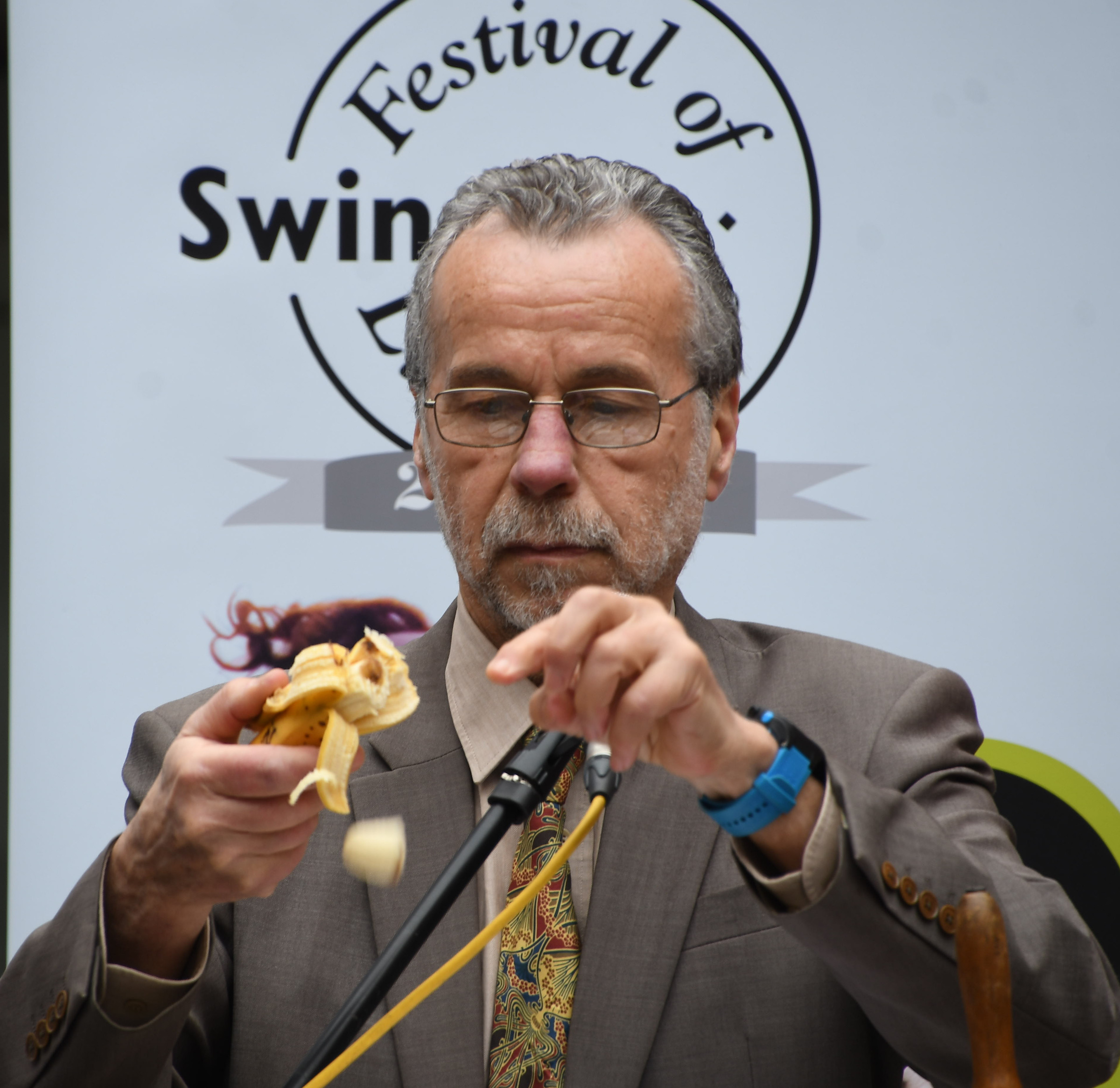
Food has always been big with the Swindon Festival of Literature Festival launch. So alongside the festival’s name spelled in aromatic ginger biscuits and other home-made grub which hungry attendees decended upon, there was some magic with a banana.

Since its launch in 1994, over twenty-five years festival director Matt Holland has grown the festival’s pamphlet of ten events into a programme of fifty authors.

And those events have brought people together for the greater good, and sometimes just with books and no food involved. They built bridges and given the controversial a voice – and what better example than founder of the ill-fated Kids Company charity, Camila Batmanghelidjh (16th May). When she last came to the festival in 2012 she was well respected and loved. This time it’s to answer her critics and the effect of the charity’s demise on children’s services. Continue reading

Who’s Telling Me What? – All the action from the Festival Finale

14 May

Our extraordinary night kicked off with a crescendo. Dancing out from the wings, with high verbal drop-kicks and punchy music, the Tongue Fu Band lit the gig, lit the Swindon Festival of Literature Finale. I hadn’t noticed him last night at the Think Slam, yet Fu frontman Chris Redmond, must have heard my Think Slam three minutes as he threw out at us “There is only here. There is only now” Continue reading

“H” Reveals All About “M” – Henry Hemming at Central Library

14 May

Henry-Hemming

Since I do not want to have to shoot you all, I cannot tell you what was said by “H” about “M”. Renowned writer Henry Hemming, hereinafter referred to as “H”, uncovered, first Head of MI5, Maxwell Knight, hereinafter referred to as “M”.

Which is a shame as an eager crowd, who were, during the secret talks, checked out themselves as to whether they were good enough liars to be spy material, they will say to a man, and this secret talk was (hand covering this reviewer’s mouth) largely about women spies, the crowd will say “Ummm it was ‘interesting’. Goodness is that the time? Sorry I have to go.” Continue reading

Crowded with letters – writing workshop

13 May

In the Festival Writing Workshop, Alice Jolly shares the elements of a compelling story: detail, viewpoint, structure and editing.

It is an excellent introduction to fiction and memoir writing on the last day of Swindon Festival of Literature. Usually by this point, winter has moved to summer and Lower Shaw Farm is the first to trap the rays. Sun on the Sunday previous baked both kids and adults at the Children and Family Day, but today a chilly wind is on the menu.

No matter. Inside the converted shed, teachers, civil servants, retired people, mums and dad warm up with homemade soup and flapjacks and hone our prose. Some have never written before, some are already published, so it will be a challenge for Alice to teach to that range.

DETAILS are introduced with two poems: Handbag by Ruth Fainlight (‘My mother’s old leather handbag / crowded with letters she carried / all through the war‘) and Death of a Peasant by Welsh poet, R. S. Thomas (‘Lonely as an ewe that is sick to lamb‘). The key is picking ‘one detail which will create a much wider world,’ says Alice. Both poems engage all five senses – it is so easy to linger on the observations of sight and forget the other ways we absorb a scene, a story and make memories. ‘Show not tell’. Make the reader feel the sadness of the character, don’t tell the reader a character is sad. Continue reading

Stephen’s Law

13 May

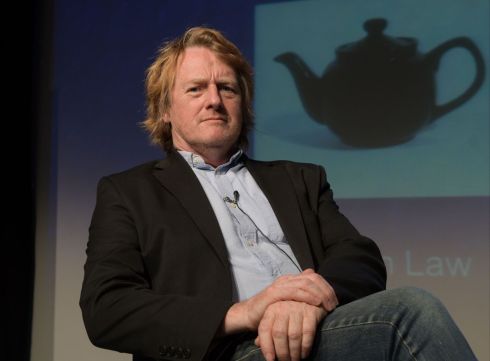
Stephen Law © Calyx Picture AgencyI worry about the crowd at Stephen Law’s philosophical talk last night on Believing Bullshit: how not to get sucked into an intellectual black hole (also the title of his book).

Stephen is keen to provide ‘immunity to indoctrination’ by encouraging more critical thinking. So he took us through possible ways we could have baseless beliefs.

After, he asked us to discuss which of these created the better belief. Answers included peer pressure, repeated soundbites (‘strong and stable’ times 100), generational belief, bigging up the dominant belief and discrediting other belief (fake news), pleasure (a giant dangling carrot), and fear.

No one suggested science and reason, said Stephen, the best way to filter out falsehood. Continue reading

Think! It’s the Law.

13 May

This slideshow requires JavaScript.

The always intriguing Think Slam posed answers and gave questions in its usual, unusual way.

A packed Arts Centre seemed thankful for the thinkful competitors whose bravery in the face of thought never ceased to amaze.

Sara-Jane Arbury introduced the 8th ‘Think Slam’ incarnation and was quick to point out that the Swindon Festival of Literature hosts the only event of its kind in the country.

A chill must have coursed the collective spines of the Think Slammers as philosopher Stephen Law was press-ganged into the role of judge supremo – his latest book is Believing Bullshit: How Not To Get Sucked Into An Intellectual Black Hole.

But bullshitters these thinkers were not, as they presented a typically varied and at times surprising window on their world. Each competitor had a three-minute time slot in which to make their argument in the most effective way possible.

John Yates, a self-identifying Remainer still stunned by BREXIT got proceedings underway with a suggestion that a byproduct of dramatic political change could be the dismantling of our political system. Continue reading