Archive by Author

Swindon LitFest crowd gets a peek into Churchill’s Cabinet room… and Lord David Owen’s mind

6 May
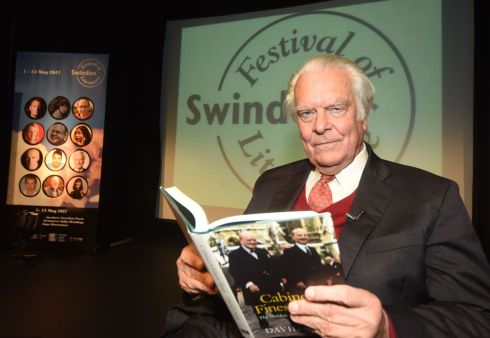
Lord David Owen © Calyx Picture Agency

Lord Owen, photo (c) Calyx Picture Agency

Over the past few years, the Swindon Festival of Literature has coincided with an important political event of one kind or another, and there’s always a political heavyweight on hand with whom to discuss the big issues of the day.

In 2015, we commiserated with Alan Johnson, whose Labour Party had lost the general election in the same week that his beloved Queens Park Rangers were relegated.

In 2016, Ken Livingstone provided some post-Corbyn, pre-Brexit insight, flying the (red) flag for backing Remain in the referendum. And there was a message of foreboding from Sir Vince Cable, who warned that older voters might drive an exit from the European Union, at the expense of the young.

Friday evening’s hour with Lord David Owen came the day after the Conservatives did very well in the Shire Hall elections – at the expense of Labour and especially of UKIP, who seem to have disappeared from the political agenda altogether – and just over a month before the nation heads to the polls for its second general election in as many years.

Continue reading

Read the Daily Mail, Guardian columnist Polly Toynbee urges Swindon Festival of Literature audience

4 May

Guardian columnist Polly Toynbee, once described by The Independent as Queen of the Leftist Journalists, has said everyone should read the Daily Mail.

Toynbee was responding to questions from a Swindon Festival of Literature audience about the effect of government cuts to the public sector, the subject of her new book, Dismembered.

In the face of a system run by emboldened libertarians, she and co-author David Walker, former director of public reporting at the Audit Commission, and Guardian contributor, were asked what we – as ordinary citizens – could do.

“There’s one thing we can do daily, and that’s not buy the Daily Mail,” said Walker, to rapturous applause.

Toynbee, though, was having none of it. “We’re living in a bubble of the likeminded,” she scolded. “Eighty five percent of the press is rightwing – and more rightwing than it used to be.

“You have to understand the forces you are up against. Read the Daily Mail, even if you have to pick it out of a bin.” Continue reading

Birds, wheelchairs and bamboo sticks

3 May

Benedict Allen’s first meeting with BBC security correspondent Frank Gardner was inauspicious. Ben Fogle! He said (or something like it), I’m a huge fan!

Despite this, Benedict and Frank became big friends, with Benedict sharing his stories of the birds of paradise in the untouched jungles of Papua New Guinea of the 1980s. Turns out, Frank is a massive fan of bird watching, and his dream was to see those very birds.

Benedict was a semi-retired solo-adventurer. After three decades of exploring, he lost a husky on the Arctic ice and felt his luck had finally run out. So back he went home and began to raise a family.

But Benedict was inspired by Frank’s dream to see the birds. Especially so as the journalist’s mobility was reliant on a wheelchair after being shot in Saudi Arabia by terrorists. And, no doubt, excited by the extreme challenge of taking a wheelchair user to a remote, humid forest decidedly not accessible. Continue reading

A grass-fed message of hope

3 May
Graham Harvey

Graham Harvey (C) Calyx Picture Agency

I feel guilty about coming here with a gloomy talk, said Graham Harvey at the Swindon Festival of Literature.

Gloomy to me means pessimistic, lacking in hope. This talk, however, had a very clear idea of what we could do to fix things. And I hope this account gets all the facts right and does justice to his excellent talk.

The problem, according to Graham, is with modern agriculture. And the answer is to look back at the past. He showed us a Thomas Gainsborough painting, Mr & Mrs Andrews, in an idyllic North Essex setting. Gainsborough would have probably recognised the landscape right up until the 1960s, Graham told us, demonstrating with another picture – this time an aerial photo of the same, unchanged countryside – courtesy of the wartime Luftwaffe. In fact, the countryside hasn’t changed much since at least Roman times.

So what happened? Continue reading

From Aristocratic playground to American Hospital and Beyond – Lydiard House

2 May
Sarah Finch-Crisp

Sarah Finch-Crisp with Festival Director Matt Holland ©Calyx Picture Agency

Today was not the first time I’ve got soaked en route to a Swindon Festival of Literature event. I’m soooo glad I bought those new flip flips in the most recent Debenham’s Blue Cross Sale. Sigh.

So when my sodden self staggered into the room in the Lydiard House conference centre where the talk on the story of Lydiard House and Park was being held it was already pretty full. By the time the talk commenced it was standing room only.

Such a level of interest is unsurprising of course. In a town full of treasures of every kind Lydiard House and Park has to be Swindon’s equivalent to the Koh-i-Noor diamond. Both are much loved and the latter is much used. And, given the recent hullabaloo around SBC’s suggestion that management of it all go out to private tender, and everything around that, (to simplify the story somewhat) there was ever likely to be a big turnout.

The 260 acres of parkland we have today is what’s left of several thousand acres. Its survival is little short of miraculous. It’s extraordinary. And even better it’s in Swindon.

The fact that we’ve got it at all is largely down to the visionary town clerk David Murray John – he of the tower in the town centre. Facilitated by the philanthropy of Councillor Francis Akers who used his own money to temporarily buy the house and park in 1943, DMJ ensured the safety and preservation of Lydiard. And all at a time of graver national concerns. So thank goodness for them.

So what did I get from Ms Finch-Crisp to make my soaking worthwhile? Continue reading

Dawn Chorus and the case of the girl-eating cockerel

1 May


Chroniclers Milo (age 10) and Louisa (Mum) went to the Swindon Festival of Literature’s Dawn Chorus, the sunrise launch event at Swindon’s Lawn Woods. When they returned, Louisa asked Milo to write this chronicle but he was too tired after a 5.30am start. Meanwhile, Louisa (sensibly) like a grown up, went back to bed for a nap, while Milo played XBox. So Louisa, keytapping fingers refreshed, interviewed Milo instead. (In breaking news, lack of sleep makes a ten year old silly.) Continue reading

From cuneiform to graffiti – Swindon Festival of Literature has all writing bases covered

16 Mar

As Swindon Festival of Literature inches towards its quarter century, different methods of written communication – from the oldest to the very recent – will be celebrated this year.

Unveiling the 2017 programme at Swindon Library today (Thursday, March 16) festival director Matt Holland mused on how the way we use writing to communicate our thoughts is changing.

“In a digital world where the currency of topical commentary can be successfully and powerfully compressed into 140 characters – definitely a great method of instant communication – the book is still doing remarkably well,” he said. Continue reading

Andra Simons

14 Oct
Andra Simons

Andra Simons

Andra Simons blew me away.

The last poet to read at Poetry Swindon Festival – poetry was actually banned after him – and it felt a fitting send off.

“I heard him and thought he was special and wanted to share him,” said director, Hilda. This is the job of an artistic director as far as I’m concerned – to have impeccable taste.

Andra is from Bermuda; he yelled, he repeated words into a rhythm, he smeared facepaint all over his poetry film, he mentions LGBT issues, and showed his love for his mom.

Andra’s work could have been a tirade of bitterness. He’s the son of an illegitimate child who was called ‘the bastard’ at school – by the teachers – and it was assumed that neither Andra’s father or his offspring would amount to anything. Continue reading

Poetry publication advice

13 Oct
Nia Davies

Nia Davies of Poetry Wales

Poets, how can you get your poem in print?

Nine Arches Press and Under the Radar editor, Jane Commane, and Poetry Wales magazine editor, Nia Davies, was in conversation with poet, reviewer and lecturer, Dr Carrie Etter, at Poetry Swindon Festival.

Here’s their thoughts:

Q. How much time should a poet leave before chasing an editor regarding their poetry submission for publication?
A. Give a month longer than the time period specified by the publication. No one will penalise you for (gently) enquiring after the fate of your poem. Both Under the Radar and Poetry Wales use online process Submittable, which visibly tracks the progress of the poem with the editor. Continue reading

Dogs and cats

11 Oct

I am Dog.

It is the final day of Poetry Swindon’s festival. For an entire week, I have stood silently in the Tent-Palace of the Delicious Air, watching and listening as poets spin colours from words. Now I leave my china body and send my spirit out across the festival.

Focus…

I am in the Richard Jefferies Museum. Daljit Nagra’s masterclass has begun. There is a fine table covered in sleek green leather. Daljit sits at one end, like a friendly teacher. Like a friendly headmaster.

Some of the students are established poets. Others are relatively new to the poetry world. One, in particular, feels like a pretender. The word “master” is not a term he identifies with.

Focus… Continue reading