Archive by Author

On iced buns and rubbish trees

8 Oct


A few bleary adult faces were prepping the Children’s Open Mic Talent Show this morning after the 3am mini party finish in the Tent Palace of the Delicious Air last night. Alas it started waaay after I had retired to bed but at least I didn’t look green today.

We were chewing our nails a little. At first it looked like the only kids were going to be the host (chronicler Milo), the guest poet Sophie Daniels and their siblings. But it was alright on the night (morning) when the chairs and bean bags filled with children anxious to take a turn on the mic.

So we had poems, jokes, poem-jokes, a bit of Milo, a welcome lot of A.F. Harrold the honorary adult poet and even more of Dr Seuss’s Green Eggs and Ham. A.F. tackled serious business like iced buns in an iced bun shop, the perils of a midnight feast, and rubbish trees. Nine year old Sophie’s set showed her a miniature poet-in-waiting with an edge of darkness. Milo had to bravely act his way through Michael Rosen’s Little Rabbit Foo Foo – with the assistance of Sophie’s sister Grace and audience participation – after his sister Sydney got a serious attack of stage fright and not even the extreme bribery of chocolate cake would entice her onstage.

A.F. Harrold was a consummate professional, even when toddlers tried to upstage him by taking the mic mid-poem, and Milo (and the other kids queuing to get their A.F. books signed) finished the event with a big fat smile on his face.

Written by Louisa Davison

Children’s Open Mic Talent Show took place at the Richard Jefferies Museum, 8 October 2017, as part of Poetry Swindon Festival.

Poets and Publishing #2

7 Oct
Poets and Publishers 2017

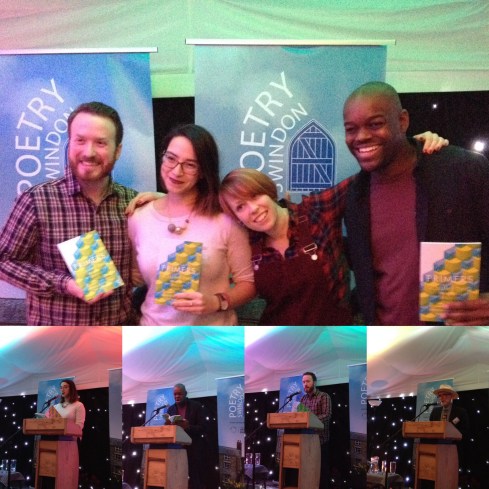
From left: Mary Jean Chan, Carrie Etter, Amy Wack

For the second year running, much-published poet and University Reader Carrie Etter quizzes two publishers from the world of poetry for tips on getting published.

This year, Carrie talked to Seren Books editor Amy Wack and Mary Jean Chan, co-editor of Oxford Poetry.

Amy is more of an unashamed traditionalist, a ‘sucker’ for form but ‘like it when people change my mind’. She is drawn to universal themes of nature, love (‘it worked for Shakespeare’) and bereavement. But she hasn’t had a transgender-themed submission and thinks it’s about time. There is a discussion about the importance of themes in collections – what if you have lots of good work, but no particular theme? It’s all about marketing, says Amy. Themed collections are easier to sell. Continue reading

Deathcap mushroom babies and other stories

7 Oct
Poetry Primers

From left: Ben Bransfield, Cynthia Miller, Jane Commane (Nine Arches Press), Marvin Thompson. Bottom right: Tony Hillier

Regarding the quality of Poetry Swindon’s hosts, as I’ve written before, if you want a note-free host who knows more about the poet’s work than their own mother, Sam is your man. He makes the kind of celebratory introduction that forces an advance apology from the poet. And not forgetting Poetry Swindon’s finger-clicking and foot-stomping founder and leader, Hilda. I remember when Hilda could barely stand in front of a crowd. These days she has comic timing that would cause a stand-up to ask if she ran performance workshops and encourages us to encourage the poets with the clapping, cheering and whooping usually reserved for slams.

Yesterday, Tony was the cheerleader for Poetry Swindon Festival’s Poetry Primers, who had not a droney ‘poetry voice’ between them. I wasn’t sure at first about Ben Bransfield’s slow pace but then realised this enabled the absorption of unfamiliar words, phrases and lines, when the norm is for whole poems to gust by on a gale of inattention. One memorable poem owned the line ‘as you do’ as Ben contemplated fatherhood of a deathcap mushroom baby (I’m guessing in the vein of ‘We Need to Talk About Kevin’). Later he riffed on Scrooge and Jacob Marley as lovers which makes total sense if you think of it in the context of waking up drunk and imagining randy ghosts. Continue reading

Singh Songs and other poems beginning with S

6 Oct

You know that moment when you finally get what a poem means and then you realise – aghast – that every time previously you’ve heard the poet read it you’ve been smiling faintly or staring at the floor and then you realise IT’S A SAD POEM. This happened to me before when I submitted a poem celebrating my newly born daughter for critique to a writers group at the same time as another writer submitted a poem about her dead baby son and I still didn’t realise until critiquing it at the group when suddenly the penny dropped. Continue reading

Poetry and the film and the lecture

6 Oct

The second two Poetry Swindon Festival events were proper clever. Left me with a lot of thoughts which, to do the whole process justice, I’ll pose as questions.

The first asked us, is poetry film, poetry?

After a series of mesmerising shorts from the 1920s to last year – Swoon, Man Ray, Eduardo Yagüe, Hans Richter, Barbara Hammer, Tom Konyves, Dave Bonta – I wondered if poetry film is an intellectual exercise, or whether it speaks to us emotionally at a deeper level that bypasses intellect. Not that there’s anything wrong with ‘intellectual’ – unless it’s trying to shut others out with its cleverness. If you’ve met the lovely poetry film makers Elephants Footprint A.K.A. Chaucer Cameron and Helen Dewbery, you’d know inclusiveness was the only thing on the table.

Like contemporary dance, poetry film creates its own visual language of movement that feels beyond text. In appreciating poetry film, do we let go of brains instead of trying to hold onto them? Continue reading

Back to Upfest – where the art went up, and the rain came down

31 Jul

Europe’s largest street art event returned to Bristol at the weekend.

Upfest included the work of 350 artists, some working on small boards, others on large panels – temporary pieces that will go when the festival packs up.

But the wall murals – some three or four storeys high – will remain for the next 12 months, which is great news for Festival Chronicle, because – thanks to both the rain and the sheer scale of the event (it’s now two miles end-to-end, without a detour to Redpoint Climbing Centre or South Street park) – we only got to see about half of it when we visited on Saturday. Continue reading

Who’s Telling Me What? – All the action from the Festival Finale

14 May

Our extraordinary night kicked off with a crescendo. Dancing out from the wings, with high verbal drop-kicks and punchy music, the Tongue Fu Band lit the gig, lit the Swindon Festival of Literature Finale. I hadn’t noticed him last night at the Think Slam, yet Fu frontman Chris Redmond, must have heard my Think Slam three minutes as he threw out at us “There is only here. There is only now” Continue reading

“H” Reveals All About “M” – Henry Hemming at Central Library

14 May

Henry-Hemming

Since I do not want to have to shoot you all, I cannot tell you what was said by “H” about “M”. Renowned writer Henry Hemming, hereinafter referred to as “H”, uncovered, first Head of MI5, Maxwell Knight, hereinafter referred to as “M”.

Which is a shame as an eager crowd, who were, during the secret talks, checked out themselves as to whether they were good enough liars to be spy material, they will say to a man, and this secret talk was (hand covering this reviewer’s mouth) largely about women spies, the crowd will say “Ummm it was ‘interesting’. Goodness is that the time? Sorry I have to go.” Continue reading

Crowded with letters – writing workshop

13 May

In the Festival Writing Workshop, Alice Jolly shares the elements of a compelling story: detail, viewpoint, structure and editing.

It is an excellent introduction to fiction and memoir writing on the last day of Swindon Festival of Literature. Usually by this point, winter has moved to summer and Lower Shaw Farm is the first to trap the rays. Sun on the Sunday previous baked both kids and adults at the Children and Family Day, but today a chilly wind is on the menu.

No matter. Inside the converted shed, teachers, civil servants, retired people, mums and dad warm up with homemade soup and flapjacks and hone our prose. Some have never written before, some are already published, so it will be a challenge for Alice to teach to that range.

DETAILS are introduced with two poems: Handbag by Ruth Fainlight (‘My mother’s old leather handbag / crowded with letters she carried / all through the war‘) and Death of a Peasant by Welsh poet, R. S. Thomas (‘Lonely as an ewe that is sick to lamb‘). The key is picking ‘one detail which will create a much wider world,’ says Alice. Both poems engage all five senses – it is so easy to linger on the observations of sight and forget the other ways we absorb a scene, a story and make memories. ‘Show not tell’. Make the reader feel the sadness of the character, don’t tell the reader a character is sad. Continue reading

Stephen’s Law

13 May

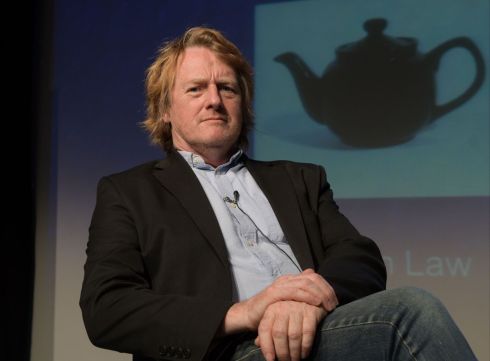
Stephen Law © Calyx Picture AgencyI worry about the crowd at Stephen Law’s philosophical talk last night on Believing Bullshit: how not to get sucked into an intellectual black hole (also the title of his book).

Stephen is keen to provide ‘immunity to indoctrination’ by encouraging more critical thinking. So he took us through possible ways we could have baseless beliefs.

After, he asked us to discuss which of these created the better belief. Answers included peer pressure, repeated soundbites (‘strong and stable’ times 100), generational belief, bigging up the dominant belief and discrediting other belief (fake news), pleasure (a giant dangling carrot), and fear.

No one suggested science and reason, said Stephen, the best way to filter out falsehood. Continue reading